
Credit foto: Sailko · CC BY 3.0
Town
Orgosolo
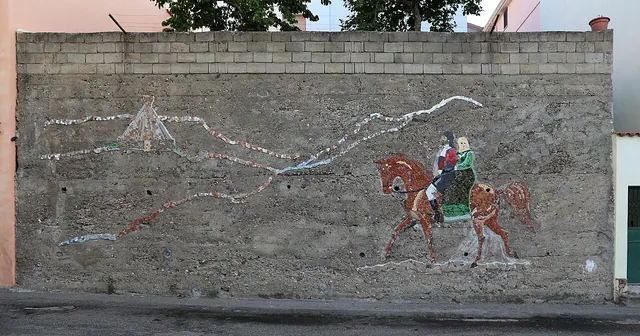
Orgosolo is one of Barbagia’s most recognisable villages, thanks to the murals that turn its streets into an open-air museum. Beyond the town lies a spectacular landscape dominated by the Supramonte, with forests, canyons and archaeological remains.
The murals of Orgosolo
The murals are Orgosolo’s best-known feature, appearing along streets, squares and building façades throughout the centre. Emerging mainly from the late 1960s and developing over the following decades, they address social, political, historical and cultural themes. Walking among them is like reading a collective story that has made Orgosolo known far beyond Sardinia.
The historic centre and local identity
Beyond its murals, Orgosolo has a historic urban fabric of narrow streets, stone houses and spaces where everyday life remains closely connected to tradition. Pastoral culture is still central to the area’s identity and can be seen in local food, festivals and collective memory.
Canto a tenore and traditions
Canto a tenore is one of Sardinia’s most distinctive musical traditions, and Orgosolo is one of the communities most closely associated with it. A visit can therefore reveal not only the murals but also the music, oral traditions, crafts and customs of Barbagia.
The Supramonte of Orgosolo
Outside the village lies the Supramonte, a vast limestone plateau characterised by forests, gorges and wild landscapes. Hiking routes cross an area rich in prehistoric and Nuragic remains, including settlements, domus de janas, menhirs and nuraghi. Some routes require experience or a local guide.
Things to see nearby
Orgosolo fits naturally into an itinerary through central Sardinia together with Nuoro, Oliena and the Supramonte. With more time, the village can be combined with hikes, archaeological visits and food-and-wine experiences for a journey focused on inland Sardinia.
How to plan your visit
The centre is easy to explore on foot, and the murals deserve time rather than a rushed visit. Excursions into the Supramonte should be planned in advance, considering route difficulty, weather conditions and whether a local guide is appropriate. A full day allows time for the village, local food and a short experience in nature.