
Place · Paulilatino
Santa Cristina Sacred Well
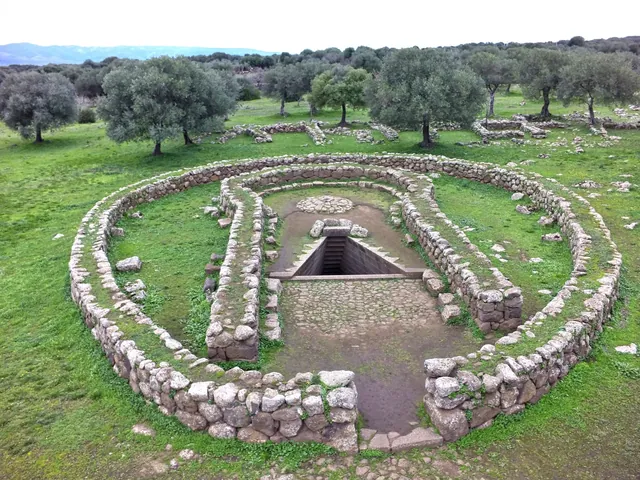
The Santa Cristina Sacred Well, near Paulilatino in west-central Sardinia, is one of the island’s most fascinating, best-preserved and mysterious Nuragic well temples. Dating back almost 3,000 years, the archaeological site is often regarded as a high point of Nuragic sacred architecture, admired for its balanced proportions, precise stonework and carefully planned geometry.
A masterpiece of Sardinian archaeology
Giovanni Lilliu’s description
Giovanni Lilliu, widely regarded as the father of Sardinian archaeology, described the Santa Cristina Sacred Well as a masterpiece of engineering and architecture, noting how extraordinary it is that such a rational and geometrically precise structure was created around 1000 BC.
The Nuragic sacred complex
The site centres on a well temple enclosed by a keyhole-shaped sacred precinct, built from precisely worked basalt blocks. Inside, a vestibule leads to a staircase and a tholos-roofed chamber. Descending towards the sacred water basin, fed by a perennial spring, is one of the most atmospheric parts of the visit.
Water worship and astronomy
The Santa Cristina Sacred Well was primarily a place of worship, but it has also been associated with astronomical observations. This interpretation has contributed to the site’s enduring fascination, especially around full-moon nights. Today it remains one of the most evocative places for understanding the ritual world and water cults of Nuragic civilisation.
Paulilatino’s archaeological heritage
Beyond the Santa Cristina Sacred Well, the Paulilatino area has a rich archaeological landscape with domus de janas, dolmens, menhirs and more than 110 Nuragic sites. Among the best known are the Battizzonis and Lugherras nuraghi; the latter is notable for its outer defensive wall and a nearby Giants’ Tomb with a rectangular stele.
Why visit the Santa Cristina Sacred Well
Visit Santa Cristina to experience one of Sardinia’s most refined Nuragic sanctuaries, where architecture, engineering, ritual and history come together. The complex offers a powerful insight into the island’s ancient past and can be combined with other archaeological and natural attractions in the surrounding area.